 The Wizard
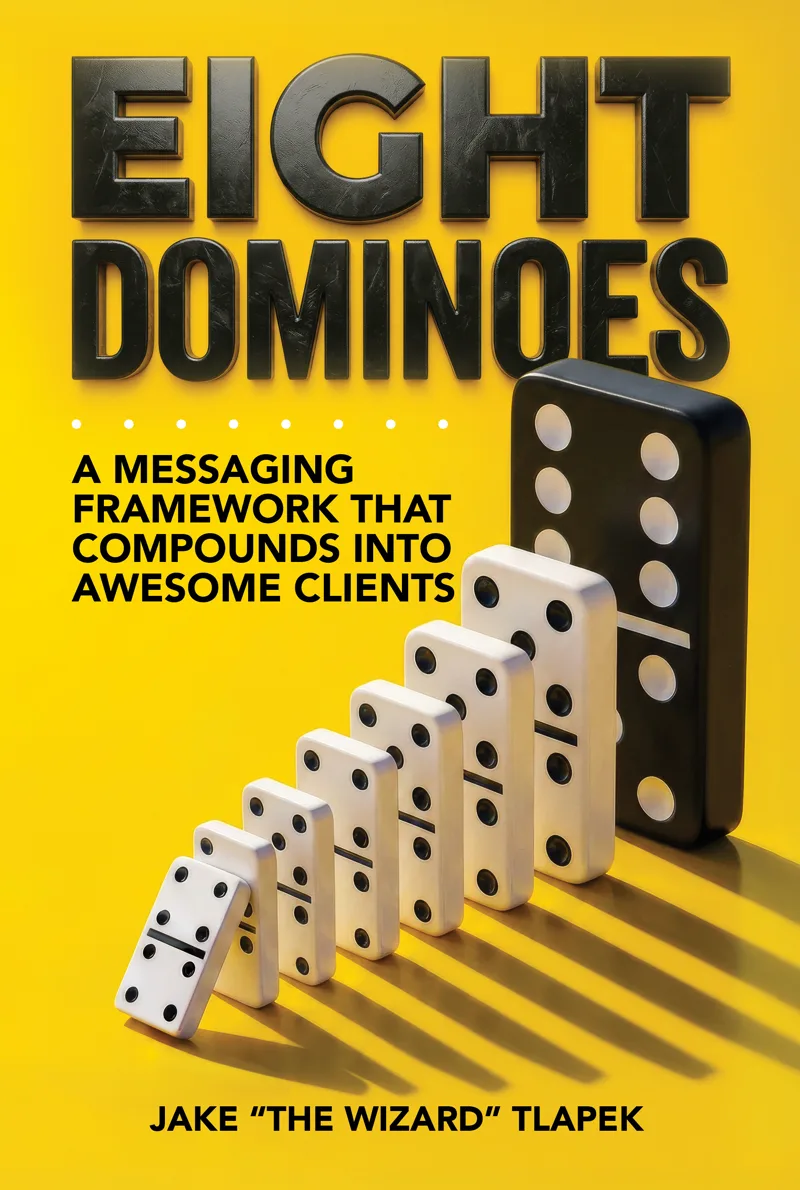
Eight Dominoes.
A messaging framework that compounds into awesome clients.
- Paperback
- Kindle
- Free on Kindle Unlimited
- Hardcover & audiobook on the way
$17.99 paperback · $9.99 Kindle · 223 pages
I wish I’d written this book.”Marty Marion Thirty years positioning Fortune 100 brands · wrote the foreword
The best product doesn't win. The best-understood product does.
You've watched it happen: a competitor with a weaker offer and a higher price eats your lunch. They didn't outspend you. They out-meant you. The distance between how good your work is and how good the market believes it is may be the most expensive gap in your business.
Most marketing advice sells you parts — a better hook, a sharper headline, a slicker funnel. All of it aimed at the logical brain. But people don't buy features. They buy dreams. Emotion makes the decision, and logic shows up afterward to justify it. Eight Dominoes teaches you to write to the part of the brain that actually decides: eight dominoes, each one making the next land harder, until a stranger chooses you.
In 1983, physicist Lorne Whitehead proved in the American Journal of Physics that a domino can topple another one and a half times its size. He started a chain with a domino under ten millimetres tall and tipped it with a wisp of cotton. Twenty-nine dominoes later, that flick fells one the height of the Empire State Building.
Messaging compounds the same way. If your work is better than your sales reflect, the problem isn't your product. It's what your customer feels when they hear about it.
Client results behind the framework
He ran the eight dominoes on his own business, then sold it
Followers earned by telling the truth, twice a day

Why this book.
Most marketing books I've read taught me tactics. Few of them taught me why people actually buy. That's the gap Eight Dominoes fills.
I spent seven years building The Wizard Marketing, an SEO and web shop, on an audience I started from zero on TikTok — talking plainly about the mistakes I kept watching small-business owners make. Then I sold it. I ran the eight dominoes on myself before I ran them on a single client. That's the credential this book rests on: I built something with the framework, then sold the thing I built with it.
Across thirteen years and every industry I've touched, the failure mode was always the same: a company with a real product, a real team, and real potential, losing to a competitor who sold the dream while they sold the specs. It wasn't the budget. It wasn't the brand. It was the dream.
I didn't learn this in a classroom. I learned it in the trenches. Eight Dominoes is not a theory book — it's a field manual. Every chapter is a move you can make in your own business the same week you read it. Read it, line up your dominoes, and tip the first one.
— Jake
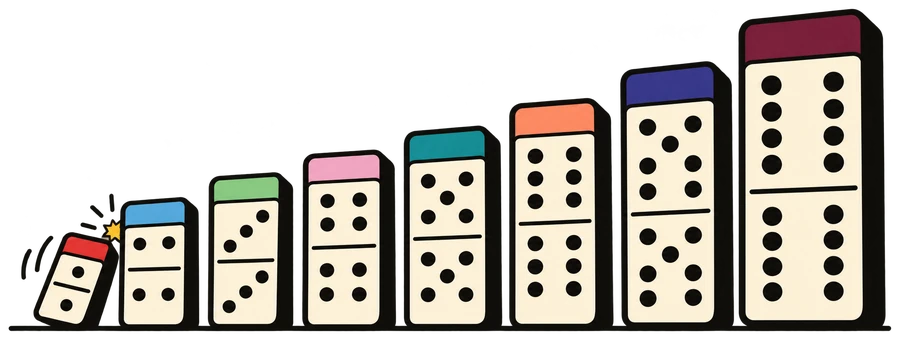
The eight dominoes.
Emotion first. Logic second. Every time.
-
01
Core Attraction
The emotion your customer is actually buying. Not the feature you're selling. Most businesses market what they built instead of why their customer shows up. This is domino one.
In the wild: neuroscientist Antonio Damasio studied patients whose emotional circuits were damaged. Logic intact — and they couldn't make the simplest decision. Emotion isn't decoration. It's the engine.
-
02
Attention Catalyst
The hook that earns the first three seconds. Without this, nothing after it gets seen. This is the one most businesses get backwards. They lead with features instead of friction.
In the wild: Obama's 2008 team tested one button word — "Learn More" beat "Sign Up" by 18.6%. The winning page was worth roughly $60 million in donations. Hooks are won in inches.
-
03
Value Proposition
The promise that earns the next sixty seconds. Not a tagline. Not a mission statement. The one specific outcome your customer is willing to pay for, stated plainly.
In the wild: Apple didn't launch a "5GB MP3 player." It launched "1,000 songs in your pocket." Same device. Different promise. Different decade of dominance.
-
04
Impact Chain
The stakes that make inaction feel unbearable. This is where you connect your product to the real cost of not having it. In their words, not yours.
In the wild: Kahneman and Tversky measured it — losing $100 hurts about twice as much as winning $100 feels good. The cost of doing nothing sells harder than any upside.
-
05
Your Mechanism
The named system that makes you unreplicable. Not just what you do, but how you do it, and why that how matters. This is how you stop competing on price.
In the wild: Domino's never claimed better pizza. "30 minutes or it's free" was the brand. Name the mechanism, own the category. (Yes, a domino made the list.)
-
06
Barrier Breakdown
The objections that kill deals. Prospects don't raise them. They go quiet and leave. This domino surfaces them and neutralizes them before that happens.
In the wild: one major retailer swapped a forced "Register" for "Continue as Guest." Purchases rose 45% — an extra $300 million in the first year (Jared Spool's famous audit). The objection was one button.
-
07
Embracing Limitations
Turning your weakness into proof. The things you can't do, won't do, or don't do, stated clearly and used strategically, are often your strongest signal of quality.
In the wild: Domino's went on television and said its own pizza was bad — and engineered one of the great comebacks in fast food. Buckley's sold a national brand of cough syrup by bragging about the taste. Stated weakness reads as truth, and truth converts.
-
08
The New Opportunity
Replacing the category instead of competing in it. The final domino turns customers into evangelists by giving them a new way to see the world, one where your product is the obvious answer.
In the wild: a $4,500 video let Dollar Shave Club take share from a $30-billion incumbent. What beat Gillette wasn't production value. It was the order the argument was made in.
A field manual.
Every chapter pairs a real turnaround with a workbook that turns the lesson into your words: how Domino's admitted its pizza was bad and engineered one of the great comebacks in fast food, how a $4,500 video let Dollar Shave Club topple a $30-billion giant, how Buckley's sold the worst-tasting medicine in the country by bragging about the taste.
Appendix A maps all eight dominoes across 30 real brands — Patagonia, YETI, Liquid Death, Trader Joe's, Chick-fil-A, Airbnb and more — so you can study the chain in the wild before you build your own.

| Author | Jake “The Wizard” Tlapek |
|---|---|
| Foreword | Marty Marion |
| Published | August 3, 2026 |
| Pages | 223 |
| Formats | Paperback · Kindle |
| Trim size | 6 × 9 in |
| ISBN-13 | 979-8190593976 |
| Category | Marketing & Sales › Advertising |
Before you ask.
Which format should I buy?
Paperback is $17.99, Kindle is $9.99, and it's free to read on Kindle Unlimited. There's a workbook at the end of every chapter, so most people who intend to actually do the work buy the paperback and write in it.
Is there an audiobook?
In production, narrated by me. A hardcover edition is on the way as well. Get on the list below and you'll hear when each one lands.
Do I need a marketing background?
No. It's written for the founder doing their own marketing as much as for the CMO. Plain language, one move per chapter, applied the same week you read it.
Is it theory, or is there work in it?
Every chapter pairs a documented brand turnaround with a workbook that converts the lesson into your own words. Appendix A maps all eight moves across 30 recognisable brands. You finish the book holding your own chain, not a highlighted paperback.
I’ve read it. Can I get help applying it?
Yes. In the Eight Dominoes Mastermind I run group consulting calls twice a week, Tuesdays and Thursdays at 11am Arizona. You bring your own offer and we work the chain on it live. It’s $500 a month or $5,000 a year, with a seven-day free trial first.
One marketing truth a week
A real example, a number, and what to do with it — plus first word when the hardcover and the audiobook land.
No drip. No filler.
No spam. One email a week. Unsubscribe anytime.