MEDIA
KIT.
Eight Dominoes: A Messaging Framework That Compounds Into Awesome Clients by Jake “The Wizard” Tlapek. Foreword by Marty Marion.
Everything on this page is cleared for editorial use in coverage of the book, the framework, or the author. Take what you need — no permission request required.
THE
BASICS.
- Title
- Eight Dominoes
- Subtitle
- A Messaging Framework That Compounds Into Awesome Clients
- Author
- Jake “The Wizard” Tlapek
- Foreword
- Marty Marion
- Publisher
- Independently published
- Publication date
- August 3, 2026
- Formats
- Paperback · Kindle · Audiobook (in production)
- Pages
- 223
- Trim size
- 6 × 9 in · B&W on white
- ISBN-13 (paperback)
- 979-8190593976
- ASIN
- B0HD48KJGD
- Price
- $17.99 paperback · $9.99 Kindle
- Language
- English
- Category
- Business & Money › Marketing & Sales › Advertising
“I wish I’d written this book.”Marty Marion Thirty years positioning Fortune 100 brands
The eight dominoes, in order
- Core Attraction
- Attention Catalyst
- Value Proposition
- Impact Chain
- Your Mechanism
- Barrier Breakdown
- Embracing Limitations
- The New Opportunity
COVER &
PHOTOGRAPHY.
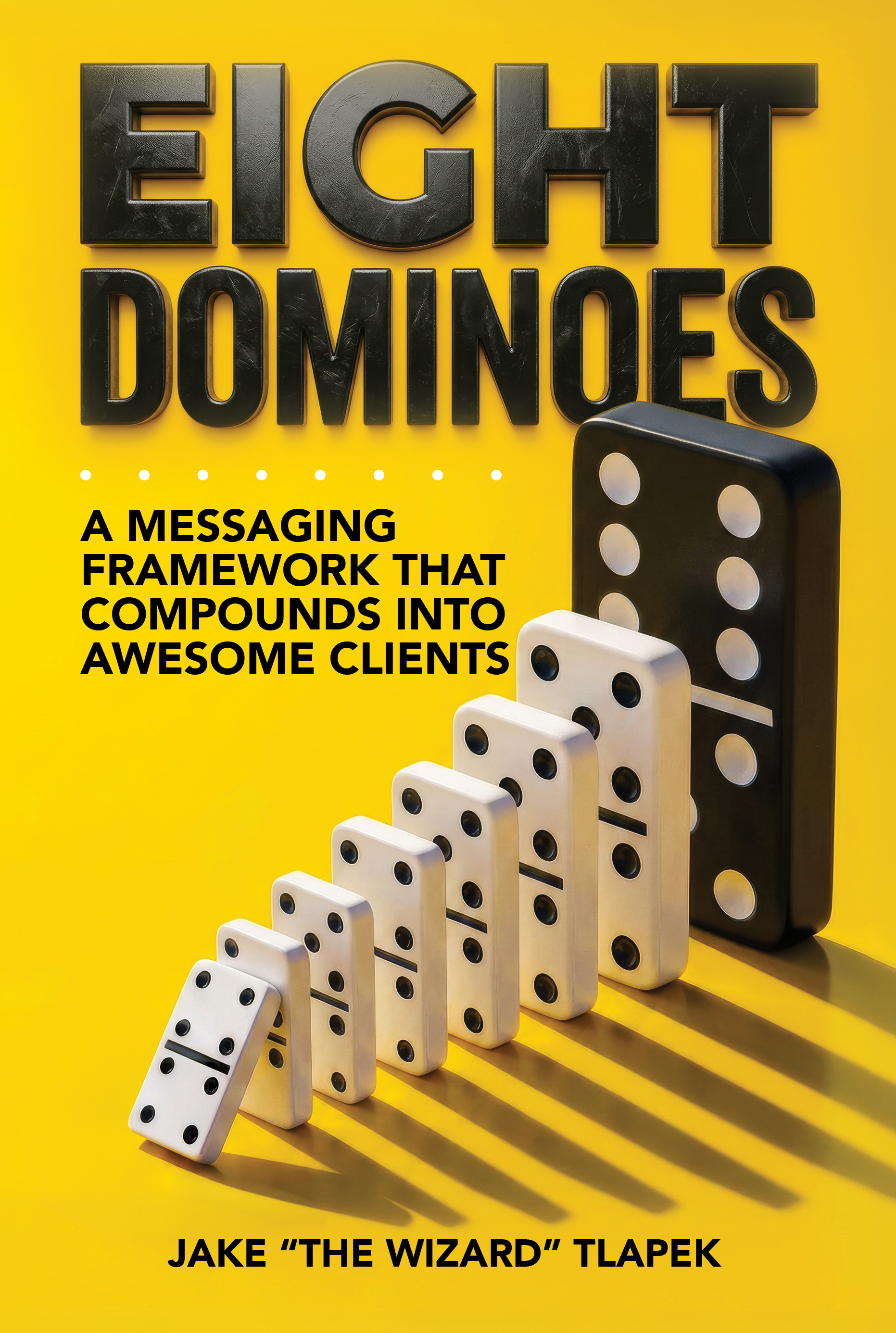
Right-click to save, or use the download link on each. Please don't crop, recolour, or overlay the cover — the full-wrap PDF is there for layouts where the front alone doesn't fit.
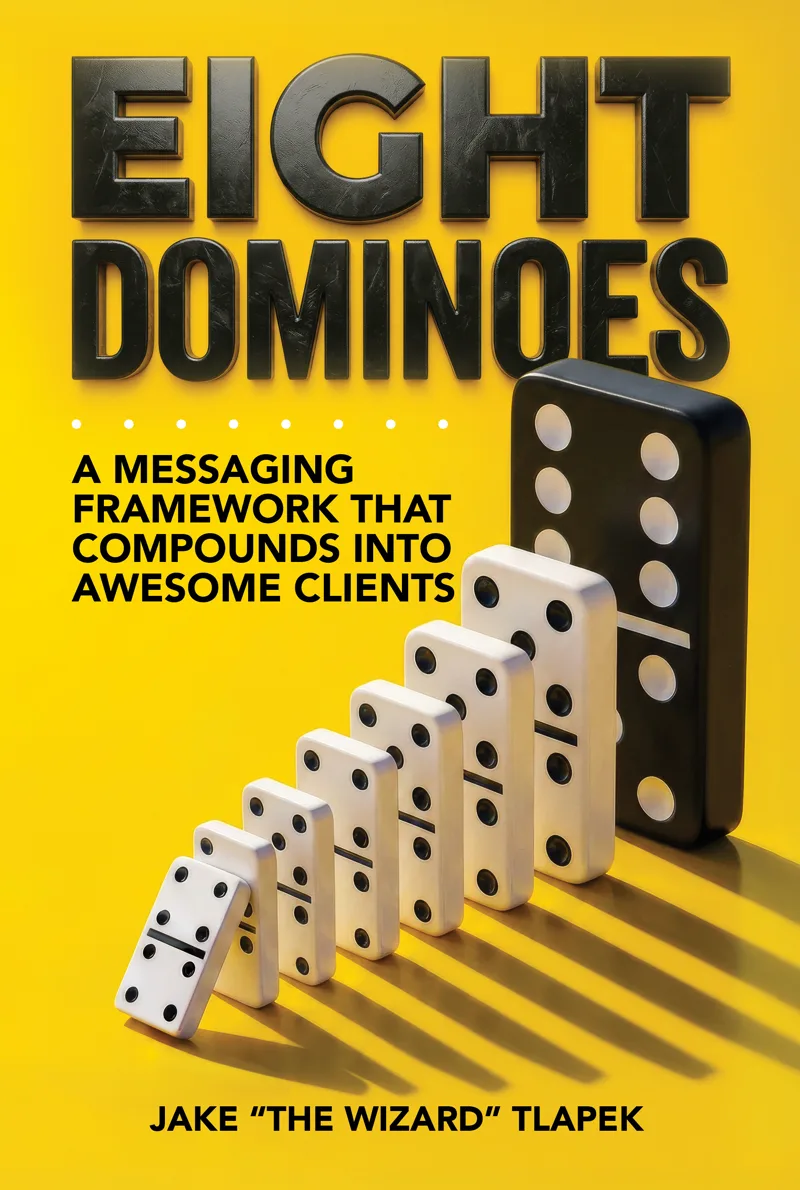
Full wrap — front, spine, back
Print-ready PDF with bleeds, RGB. For layouts the front alone doesn't suit.
Download PDF · 17 MB →

THREE
LENGTHS.
Take whichever fits the column.
Short — 36 words
Jake “The Wizard” Tlapek built a Chicago marketing agency on an audience he started from zero, grew it seven years, and sold it. He never changed a client's product — only the order of their words.
Medium — 79 words
Jake “The Wizard” Tlapek spent seven years building The Wizard Marketing, a Chicago SEO and web shop, then sold it. He grew it on an audience he started from zero on TikTok, talking about the mistakes he kept watching small-business owners make. He ran the eight dominoes on himself before he ran them on a single client. Eight Dominoes is the framework that came out of it, and the platform of the same name is where it gets deployed.
Long — 142 words
Jake “The Wizard” Tlapek is a marketing practitioner, author, and founder. He spent seven years building The Wizard Marketing, a Chicago SEO and web shop where he wrote the strategy, the copy, and the backend on the same job, and sold the agency after growing it on an audience he started from zero on TikTok — talking plainly about the mistakes he kept watching small-business owners make.
He practiced the eight dominoes on himself before he practiced them on a single client. That is the credential the book rests on: he built something with the framework, then sold the thing he built with it. Eight Dominoes distills what he learned into a sequence that holds across any channel or industry. He now builds the Eight Dominoes platform, which takes the book's workbook and turns it into working software for agencies and operators.
THE
BOOK.
One line — 31 words
A messaging framework that treats a brand's message as a sequence of eight moves rather than a pile of tactics — set them in order and a stranger becomes a client.
Short — 86 words
The best product doesn't win. The best-understood product does. In Eight Dominoes, Jake “The Wizard” Tlapek argues that the distance between how good your work is and how good the market believes it is may be the most expensive gap in your business — and that closing it is a matter of order, not volume. The book breaks messaging into eight moves built one at a time, each chapter pairing a real brand turnaround with a workbook that turns the lesson into the reader's own words.
Full — retail, 261 words
The best product doesn't win. The best-understood product does.
You've watched it happen: a competitor with a weaker offer and a higher price eats your lunch. They didn't outspend you. They out-meant you. The distance between how good your work is and how good the market believes it is may be the most expensive gap in your business. Eight Dominoes closes it.
Most marketing advice sells you parts: a better hook, a sharper headline, a slicker funnel. But a message isn't a pile of parts. It's a sequence — eight dominoes that, set in the right order, knock each other down until a stranger chooses you. Out of order, they don't fall at all.
Jake “The Wizard” Tlapek breaks the chain into eight moves you build one at a time: Core Attraction, Attention Catalyst, Value Proposition, Impact Chain, Your Mechanism, Barrier Breakdown, Embracing Limitations, and The New Opportunity.
Every chapter pairs a real turnaround with a workbook that turns the lesson into your words: how Domino's admitted its pizza was bad and engineered one of the great comebacks in fast food, how a $4,500 video let Dollar Shave Club topple a $30-billion giant, how Buckley's sold the worst-tasting medicine in the country by bragging about the taste. An appendix maps all eight dominoes across 30 real brands so you can study the chain in the wild.
With a foreword by positioning authority Marty Marion.
If your work is better than your sales reflect, the problem isn't your product. It's the order of your words. Build the chain. Watch the market fall.
Boilerplate — about the platform
Eight Dominoes is also software. The platform takes the book's workbook and turns it into a workbench for agencies, consultants, and operators who own the message for more than one brand: build each client's eight dominoes with AI drafting grounded in the framework, generate on-brand content for every channel from the finished chain, and get a prioritized daily move across the whole portfolio.
SEVEN
WAYS IN.
The most expensive gap in business isn't quality. It's meaning.
The book's central claim is that most struggling businesses don't have a product problem — they have a translation problem, and the gap between how good the work is and how good the market believes it is can be measured in lost revenue. A contrarian read on “if you're good enough, the work speaks for itself,” and it lands with owners who are genuinely excellent and genuinely invisible. Source: Chapter 1 — How to Knock Down a Skyscraper with a Pen
Domino's told America its pizza was bad. Then it won.
The book uses the Domino's turnaround as a case in what it calls Embracing Limitations — a brand admitting the exact thing its critics say, out loud, and converting the admission into credibility. Useful for any piece on corporate apology, brand honesty, or why self-criticism outperforms spin. Source: Chapter 8 — Embracing Limitations
A $4,500 video against a $30-billion incumbent.
Dollar Shave Club as a study in sequence rather than budget: the book breaks the launch down domino by domino to show that what beat Gillette wasn't production value but the order the argument was made in. A good hook for founder-audience and small-budget-marketing coverage. Source: Chapter 9 — The New Opportunity
How a cough syrup sold on tasting terrible.
Buckley's built a national brand by bragging about being the worst-tasting medicine on the shelf. The book uses it to argue that a real constraint, stated plainly, is a filter that attracts the right buyer — the opposite of the instinct to sand every rough edge off a brand. Source: Chapter 8 — Embracing Limitations
He ran the framework on himself, then sold the company.
The author isn't writing from a business school. He built a Chicago agency on a TikTok audience he started from zero, ran the eight dominoes on his own business first, and sold the agency. A practitioner-credential angle for entrepreneurship and creator-economy desks. Source: Author bio
Why AI writing tools all produce the same voice.
The framework's argument — that a message is a sequence, not a pile of parts — explains a problem readers feel every day: generative tools prompted from nothing produce competent, interchangeable copy. The author's follow-on software applies the book's chain as the input instead, which makes for a concrete tech angle on AI and brand sameness. Source: Chapter 10 — Now Go Build, and the Eight Dominoes platform
Eight dominoes, thirty brands, one appendix.
Appendix A reverse-engineers the full chain across 30 recognisable brands — Patagonia, YETI, Liquid Death, Trader Joe's, Chick-fil-A, Airbnb and more — which makes an easy explainer or listicle format: pick three brands, show the same eight moves underneath each. Source: Appendix A — Brand Stacks in the Wild
QUESTIONS
& QUOTES.
Suggested interview questions
- You open with the claim that the best product doesn't win. What does win, and how did you learn that the hard way?
- Why eight, and why does the order matter more than the individual pieces?
- What's the single most common place you see a business's message break down?
- Domino's went on television and said its own pizza was bad. Why does that work when it sounds like brand suicide?
- You argue that a real limitation is an asset. Where's the line between an honest constraint and an excuse?
- You built an audience from zero on TikTok and it grew into an agency you eventually sold. What did that teach you that agency work didn't?
- A lot of owners say they've tried marketing and it didn't work. What are they usually actually describing?
- Everyone now has an AI that writes copy. Does that make a framework like this more useful or less?
- If a business owner has one afternoon and no budget, which domino should they work on first?
- What's a piece of standard marketing advice you think is actively harmful?
Quotable lines
“The best product doesn't win. The best-understood product does.”
“People don't buy the best product. They buy the one whose meaning they understand and believe.”
“One push. Eight dominoes. A skyscraper falls.”
“It's not a quality gap. It's a meaning gap.”
“Map only the good path and the slow brain reads it as hype. Map only the bad path and it reads as manipulation. Both, side by side, is what lets the slow brain decide.”
“Limitations create texture. Texture creates memorability. Memorability creates preference.”
“You didn't build a marketing plan. You built a chain of answers, in the exact order your customer needs to hear them.”
READY
TO RUN.
For immediate release
PHOENIX, August 3, 2026 — Former agency owner Jake “The Wizard” Tlapek has published Eight Dominoes: A Messaging Framework That Compounds Into Awesome Clients, a 223-page framework arguing that most businesses lose not on the quality of their work but on the order of their words.
The book's premise is that a brand's message is a sequence rather than a collection of tactics. Tlapek breaks it into eight moves — Core Attraction, Attention Catalyst, Value Proposition, Impact Chain, Your Mechanism, Barrier Breakdown, Embracing Limitations, and The New Opportunity — and argues that built out of order they don't work at all.
“The distance between how good your work is and how good the market believes it is may be the most expensive gap in your business,” Tlapek writes. The book is aimed at the owner he describes as the best-kept secret in their market: five-star work, loyal referrals, and an inferior competitor winning on volume.
Each chapter pairs a documented brand turnaround with a workbook that converts the lesson into the reader's own language. Cases include the Domino's Pizza campaign that admitted the product was bad, the $4,500 Dollar Shave Club video that took share from a $30-billion incumbent, and Buckley's cough syrup, which built a national brand by advertising how bad it tasted. An appendix maps all eight moves across 30 recognisable brands.
The book carries a foreword by Marty Marion, a positioning strategist with thirty years of work with Fortune 100 brands, who calls it a book he wishes he had written.
Tlapek spent seven years building The Wizard Marketing, a Chicago SEO and web agency grown on an audience he started from zero, and sold it. He says he applied the framework to his own business before using it with any client.
The book is available in paperback and Kindle editions at amazon.com/dp/B0HD48KJGD. An audiobook, narrated by the author, is in production.
A companion software platform of the same name applies the framework for agencies and operators managing messaging across multiple client brands.
###
WHAT YOU
MAY DO.
- The cover art and author photograph on this page are cleared for editorial use in coverage of the book, the framework, or the author. No permission request needed.
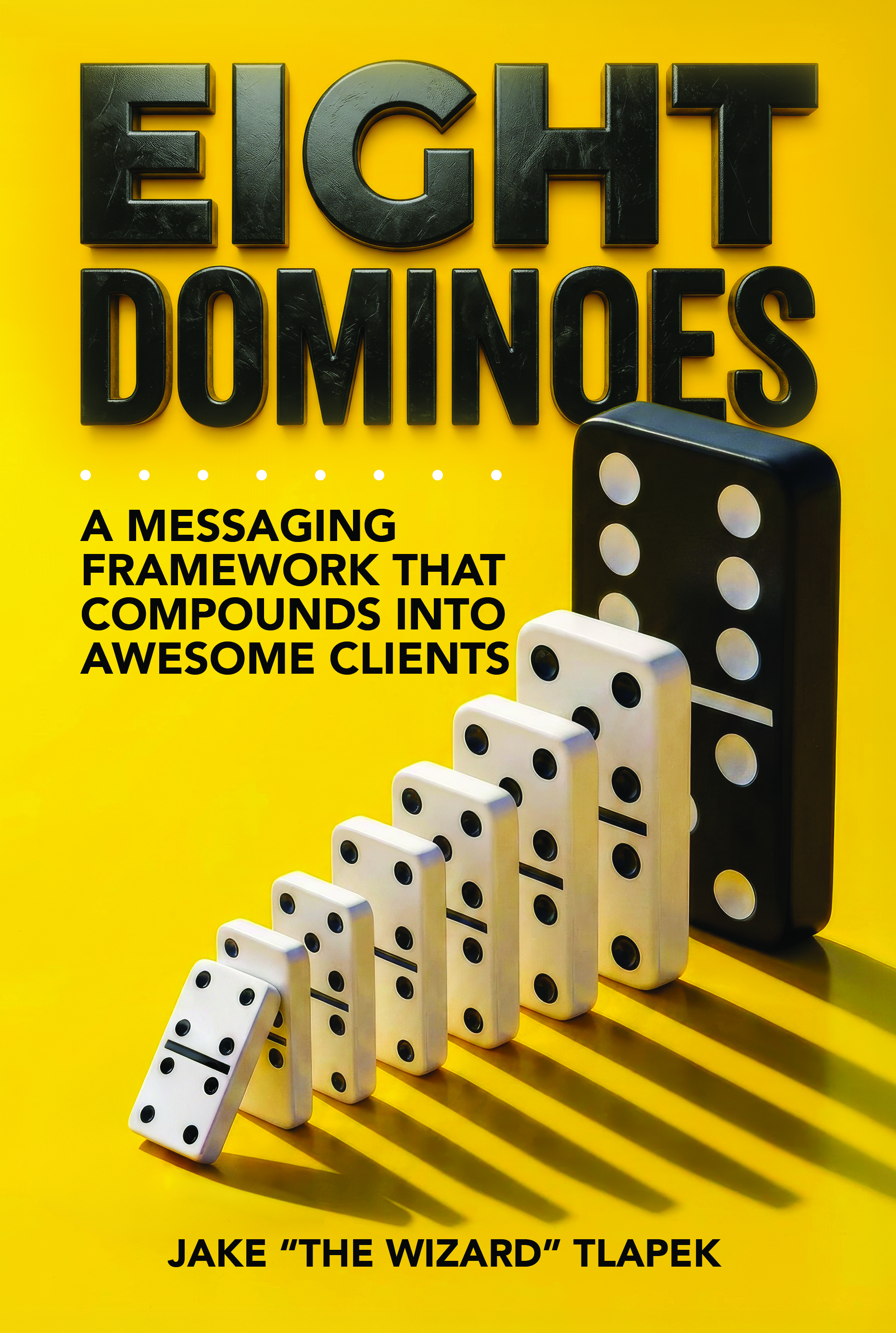
- Please don't crop, recolour, overlay, or otherwise alter the cover. The alternate render exists for layouts where a flat cover doesn't fit.
- Credit the author photo to Jake Tlapek. Credit the cover art to Eight Dominoes.
- Excerpts of up to 500 words may be quoted in a review or article with attribution to the book by full title. For longer excerpts, serial rights, or bulk-order enquiries, use the form below.
- These assets are not licensed for advertising, merchandise, or any use implying the author endorses a product or service.
Press contact
Interview requests, review copies, excerpts, and bulk orders.